


The Eye Patch Packaging Drama: What Actually Happened?


Fenty, Glow Recipe & Huda Beauty: Who Really Made the Slicing Eye-Patch Innovation?
The beauty industry has been abuzz for weeks after Fenty Skin, Glow Recipe and Huda Beauty previewed strikingly similar slicing eye-patch jars within days of one another. The internet responded with accusations of copying, "lack of innovation in the beauty industry" and a Spider-Man meme for good measure.
But behind the scenes is a Korean packaging manufacturer producing some of the latest beauty innovations, as well as a much more interesting story about how beauty products actually get made.
In this episode of The Korean Beauty Show, host Lauren Lee unpacks the packaging "disaster", disputed exclusivity claims, what “freshly sliced” actually means for a skincare product, and the questions other beauty brand founders should be asking themselves before building a launch around a supplier’s innovation.

Hear the full discussion on packaging innovation, eye-patch performance and what this launch overlap means for consumers AND beauty founders.
The Slicing Eye-Patch Timeline: Who Was First?
If you haven't seen the videos yet, allow me to set the scene. It opens with an influencer, as most beauty videos do these days. Cue the shocked Pikachu face and a close-up of the latest product being spruiked, in this case a small jar filled with hydrogel eye patches. She twists the top and the opening of the packaging appears to "cut" a fresh under-eye patch slice, which she quickly applies.
It's visually arresting, plays well on social media and the concept is easy to demonstrate on camera, making it an easy sell. The product itself also appears to address a familiar frustration, namely fishing slippery eye patches out of a tub.
Fenty Skin previewed its version in mid-September. Glow Recipe's surfaced within days, followed by yet another from Huda Beauty. Since then, multiple other brands have begun to tease their versions, including Vitamasques and Bubble.
Fenty responded with a Spider-Man pointing meme; Glow Recipe made a joke about the situation. Huda Kattan, founder of Huda Beauty, didn't appear to be laughing (but more about that later).
Then, the internet discovered that a Korean brand called Wonder Bath actually already had a product ready and selling. They called it their "Slice Serum", and it was being spruiked by influencers both inside and out of Korea; three different versions of it, no less.
So how did all of this happen?
Beauty insiders began pointing to the Korean packaging manufacturer, one of the biggest in Asia. They confirmed that yes, it was their innovation.
According to the company's US sales director, they started pitching the dispensing format in Korea in October 2025, and Wonder Bath was the first brand to release it, bringing a version to market in July 2026.
So, who Actually Created the Packaging Innovation?
The memes and copying accusations overlook an important distinction: one of attribution.
Although many were quick to point to the packaging drama as evidence of "lack of innovation in the beauty industry" this misses some nuance.
The slicing mechanism is innovative.
It not only changes how hydrogel is filled, but how it is stored, portioned and used.
That, in and of itself, is an innovation. The difference is in this case, is that it was the packaging manufacturer doing the innovating, as opposed to the brands.
In fact, the Korean packaging manufacturer behind the product designs and produces a wide range of cosmetics packaging, many of its own unique creations. Its capabilities include research and product development, mould making, injection moulding, decoration, assembly and more.
The grinding packaging it created is not limited to these eye jars but includes a wide range of grinding or slicing styles, including compacts, sticks and jars.
The manufacturer even presented a refillable version of the grinding eye-patch package at a 2026 Korean packaging award program.
So now we know WHO actually came up with this format. The next question is one of exclusivity.
Were the Brands Promised Exclusive Packaging?
This is where I want to be precise, because there is a serious allegation in the middle of what has mostly been treated as a funny story.
Huda Kattan has said publicly that the brands had been "misled" about exclusivity.
The manufacturer's US sales director disputes this, telling The Business of Fashion that none of the brands had exclusivity. He said that Fenty, Huda and Glow Recipe had all raised the subject but the company could not grant it.
Those are conflicting accounts and having not seen the contracts or the private correspondence, it’s anyone’s guess as to what any individual brand was actually promised in a meeting.
However, to my eyes, the dispenser looks like a stock mould: a new, innovative one to be sure, but one that a packaging supplier owns and can offer to more than one customer. Putting your logo and colour on a stock component does not, by itself, make the underlying component yours.
And, to be clear, this packaging manufacturer did exactly the same thing with their grinding cleansing balm mould, which was widely rolled out by many Korean brands over 2024.
Exclusivity is not a simple yes-or-no question. A brand might ask whether a supplier can restrict a particular configuration, territory, sales channel, category or period of time. The exact scope, duration and agreed terms matter.
According to the Business of Fashion report, Wonder Bath worked with the supplier on a customised version. They benefited from shorter domestic shipping times, which enabled them to be the first to bring the product to market.
At the time of that report, Wonder Bath's product was already available to buy, while Glow Recipe's was expected in the autumn.
Huda Kattan on the other hand came out publicly stating that Huda Beauty was not going to launch its version anymore.
Clearly, teasing a product and selling it are different milestones, and this story has moved quickly.
Why Did So Many Brands Preview the Same Format Together?
Think about what a packaging sales team does.
It takes a new component it has created to potential customers, shows them how it works, and tries to get orders for it. In this case, those customers are brands, not consumers.
The packaging supplier's US sales director told The Business of Fashion that he pitched this design in Los Angeles and New York across late 2025 and early 2026. Several big brands saw it and wanted it. The reality is that it takes time to bring a new product to market, no matter what packaging you're putting it in.
Brand development cycles include sampling, formula and pack compatibility work, decoration, stability checks, production scheduling, freight, retail commitments and marketing.
All of this is to say that a few days between social posts doesn't mean one team saw another's video on Monday and somehow managed to manufacture the same product by Thursday.
I think the more interesting question is what one of the retailers knew about these simultaneous launches. Many of these brands are stocked at Sephora.
Sephora (and other) retail buying teams typically see upcoming launches months before customers do.
I would be far more interested in knowing exactly what Sephora knew and whether it alerted any of the brands to the overlap.
Do Freshly Sliced Eye Patches Work Better?
For the person buying the product, the question is probably a little more straightforward: does any of this mean that the eye patches work better than what we already have?
Eye patches themselves have been on the market for years.
While the freshly sliced patches offer a twist on that, I haven't found a published head-to-head study showing these outperform traditional hydrogel patches. Now, that's perhaps not unexpected given how new the format is.
But the slicing mechanism, on its own, isn't evidence of better skincare results.
Traditional hydrogel patches already contain ingredients within the gel itself. That isn't something this dispenser invented. Glow Recipe has mentioned that its version contains caffeine, panthenol and peptides; Fenty's materials highlights niacinamide, hyaluronic acid and fruit ingredients. But those are simply different formula stories.
There is research on conventional hydrogel eye masks. One small study of 30 women reported improvements in hydration and elasticity after four weeks of use. That doesn't necessarily validate all eye patches, but it's something.
To assess the new format properly, what we would really want is a comparison against a conventional patch with a comparable formula, dose and wear time. Are we measuring hydration immediately after use? Puffiness? Changes over several weeks? How long does the improvement last? The TikTok reviews don't answer all of those questions.
There may be a useful improvement in dispensing: less fishing around in a jar, less mess, potentially better protection of the remaining product. I’ve also seen people point to better accessibility for people with disabilities, which is a definite plus.
But that needs to be distinguished from better results on the skin.
The other to note is that a patch may be freshly cut, but it's not freshly formulated. The gel was still manufactured earlier and has been sitting in its container since then, the same as any other eye patch. Cutting a slice of it doesn't magically reset its age or make the actives fresher.
Does Hot Filling Affect Skincare Ingredients?
I've also seen questions about the method of pouring the liquid into these containers, which is apparently done via hot filling.
If it's heated, then what happens to the ingredients?
That is a reasonable manufacturing question, as heat can impact active ingredients. But issues around heating the formula isn't unique to a slicing format.
Published methods for conventional hydrogel patches also involve heat. One earlier hydrogel patent describes heating the gel base above 70 degrees Celsius, cooling it below 50, then adding skincare actives before pouring it into a mould. 50 degrees is not a universal safe temperature for every active, but it does illustrate why the order of addition matters.
Some ingredients are more vulnerable to heat than others, and stability depends on the exact molecule, formula and exposure conditions. Published research on commercial retinoid products, for example, found formulation-dependent degradation during storage, with light also being an important factor. But the simple fact of the matter is that we would need data on the finished formula if we are to assume either that every ingredient survives equally well, or that heating destroys everything.
For a founder, I would ask my lab: what temperature does the formula reach, for how long, and which ingredients are added during cooling? What testing confirms the relevant actives remain at their intended levels after manufacture and through shelf life?
A gel that still looks pink and holds its shape hasn't necessarily retained every active at its original concentration.
The fair conclusion is that hot filling can place constraints on a formula that has to be designed around.

What About Packaging Waste and Refills?
Regular listeners to the show will already know I'm not a fan of grinding cleansing balms, primarily because of the packaging waste.
My concern here is similar: what exactly does this extra mechanism deliver that justifies the additional packaging used to make it?
I can appreciate the engineering and still question whether I want to buy it.
A satisfying twist makes a good video, sure, but it isn't enough to justify a more elaborate container that's harder to recycle just on its face.
Now there is a relevant manufacturing argument in favour of this format.
In its Korean packaging award submission, the supplier says direct filling and cutting at use reduce hydrogel offcuts that occur when patches are cut during production.
It also describes a refillable version with an all-polypropylene cartridge and claims a plastic saving compared with its own non-refillable container.
Factory waste and packaging waste in your bathroom are different parts of the calculation. A reduction in gel offcuts doesn't tell us how much plastic the dispenser uses, whether you can buy refills, or what happens to it when you're finished.
We also need a fair comparison. Are we comparing it with individually wrapped pairs or with a simple tub holding many patches? How many pairs does each provide? What is the packaging weight per use? How many times is the outer container actually reused? Does the refill itself require another substantial plastic component?
A supplier offering a refillable design doesn't mean a brand has launched an accessible refill system. And an all-PP pack isn't automatically collected and recycled wherever you live.
My buying preference is still to avoid extra packaging unless the practical benefit is convincing. I'd want to see accessible refills, a meaningful reduction in material per use, or a demonstrated benefit that a simpler pack cannot give.
That is also a useful question for a brand founder: are you choosing this pack because it solves a customer problem, or because the mechanism makes good content? Sometimes it can do both but ideally you would want to examine the formula, the filling process, the waste and the customer's experience together.
What Beauty Founders Can Learn From the Eye-Patch Saga
If you are starting a beauty brand, the take away from this isn't that stock packaging is bad. The reality is that most brands use it and as a new founder it can give you access to well-engineered components without paying a fortune to create an entirely new mould.
The more useful question is: what belongs to you?
Before you commit, find out whether the component comes from an existing public mould, whether other brands can order it, and what options you actually have to customise the part or its appearance.
If differentiation matters to your launch, ask about the cost and minimum quantities for your own tooling or for a genuinely distinct version.
And if exclusivity is commercially essential, discuss its scope early and have the agreed terms documented and reviewed properly by a lawyer. Don't build a campaign on an assumption made from a sales conversation.
Finally, ask yourself whether the product has a reason to exist once someone else has access to the same jar?

Developing a Beauty Product in Korea?
Korean beauty innovation is often happening well before a product appears in a celebrity brand's campaign.
Packaging companies, labs and brands each contribute different parts of what you see on the shelf. When one of those parts comes from a supplier's catalogue, you need to understand what you are buying and what everyone else can buy too.
This is the kind of work we help beauty and wellness founders think through at STYLE STORY.
At our consultancy, we work with beauty businesses looking to develop products in Korea, including the route from product idea to suitable packaging suppliers and manufacturing partners.
We can help you assess which packaging options are realistic for your formula, order quantity, timing and target market, and what questions to settle before you commit to production.
If you're planning a beauty product and want a clearer route through Korean packaging and manufacturing, you can book a manufacturing advisory call through STYLE STORY. That first call is where we review your idea and map the practical next steps; product development and supplier work beyond the call are scoped separately.

Come See Us at K-Beauty Expo Korea
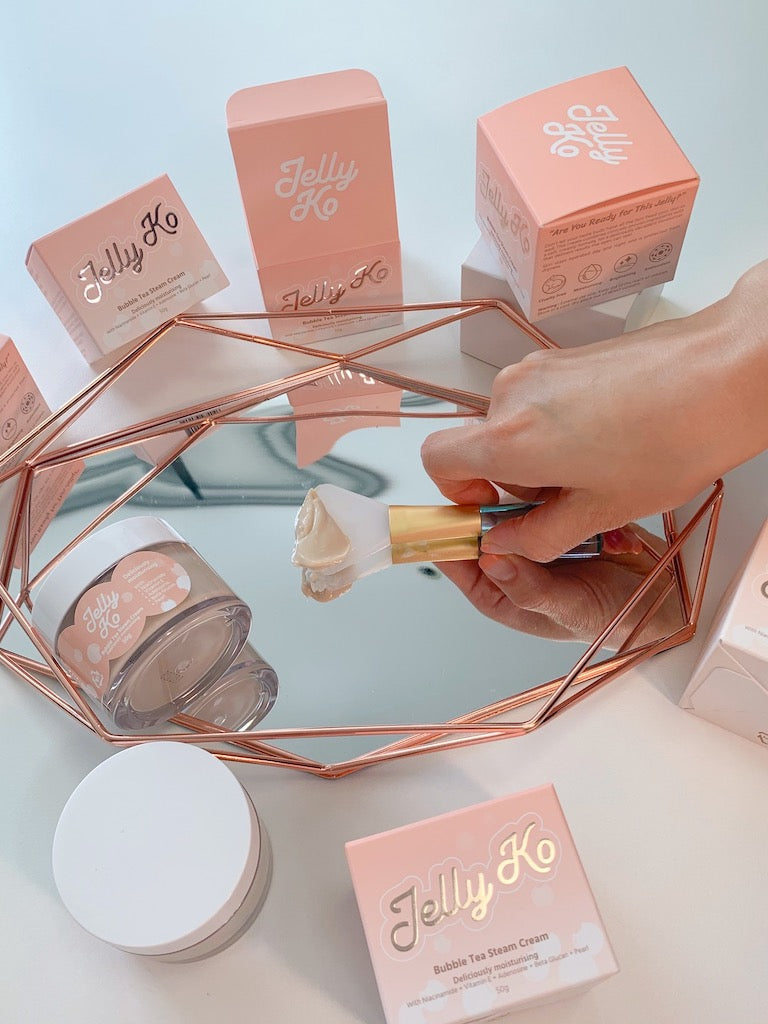
We’ll be at K-Beauty Expo Korea, 15–17 October 2026, at KINTEX in Ilsan. If you’ll be there, stop by Jelly Ko’s booth, 3E-47, near the Buyer Matching Zone, and say hello.

What Do You Think?
When those eye-patch jars started appearing everywhere, was your first reaction to the packaging. Or did you want to know what was actually inside? I’d love to hear your thoughts.
Connect with Lauren
Previous

Korean Beauty’s Blurring Technique


"Behind the scenes is a Korean packaging manufacturer producing some of the latest beauty innovations, as well as a much more interesting story about how beauty products actually get made."
Lauren Lee, Host of the Korean Beauty Show podcast
Leave a comment
Comments will be approved before showing up.